
Uvalde County Court Records After Arrest
Uvalde County court records after an arrest do not start as a mugshot gallery or as a jail roster. The first local event is usually arrest and booking, followed by a magistrate appearance under Texas Article 15.17. After that, the prosecution path controls the formal court record. The 38th Judicial District Attorney, Christina Mitchell, serves Real and Uvalde Counties and prosecutes adult felonies in the district. Felony jail booking charges can be accepted, reduced, amended, declined, or sent to a grand jury before they become the charges shown in district court records.
That distinction matters. The jail side shows custody and booking information, while court records show the legal case that follows the arrest. Use jail inmate records for current custody and booking status, and use jail mugshots for booking photo request guidance. For Uvalde County court records after jail arrest, the useful questions are which court has the case, what charging document was filed, whether bond or a capias appears, and whether the charge is pending, dismissed, reduced, or final.
Article 15.17 First Appearance
Texas Code of Criminal Procedure Article 15.17 requires an arrested person to be taken before a magistrate without unnecessary delay and no later than 48 hours after arrest. In plain terms, magistration is the first court-related checkpoint after jail intake. The magistrate gives warnings, addresses counsel issues, reviews probable cause where required, and may set bond conditions. It is not the same as a final trial court record, but it often explains why the jail says bond is set, not set, or blocked by a hold.
For Uvalde County court records after an arrest, the first appearance also helps separate short-term booking facts from filed charges. A person can be in Uvalde County Jail while the prosecutor is still reviewing the case. A court cause number may not exist right away. If the jail confirms custody but no clerk can locate a case, the case may still be in intake, pending filing, routed to the wrong court for the search, or held on a warrant from another agency.
Find Uvalde Court Records After Arrest
No official Uvalde criminal case-search form with inspectable search fields was located in the research. The Uvalde County District Clerk is the custodian of district court pleadings and papers, and felony cases route through the district court path. The 38th District Court page lists Judge Kelley T. Kimble and the Uvalde courthouse contact. The County Clerk page advertises online records and fee schedule links, but the research did not verify a public criminal charge portal for county-level misdemeanor searching.
- Confirm the arrest and booking status with the Uvalde County Sheriff's Department before assuming a court case has been filed.
- Ask which court should receive the charge: municipal court, county-level court, or the 38th District Court.
- For adult felonies, contact the District Clerk, District Court, or 38th Judicial District Attorney for the filed case path.
- For city ordinance or Class C matters, check with Uvalde Municipal Court.
- Request the cause number, charging document, charge status, settings, bond entries, capias entries, and disposition if the case is final.
The official District Clerk page is the local source that explains custody of district criminal papers. The screenshot below comes from the Uvalde County District Clerk page referenced in the research.
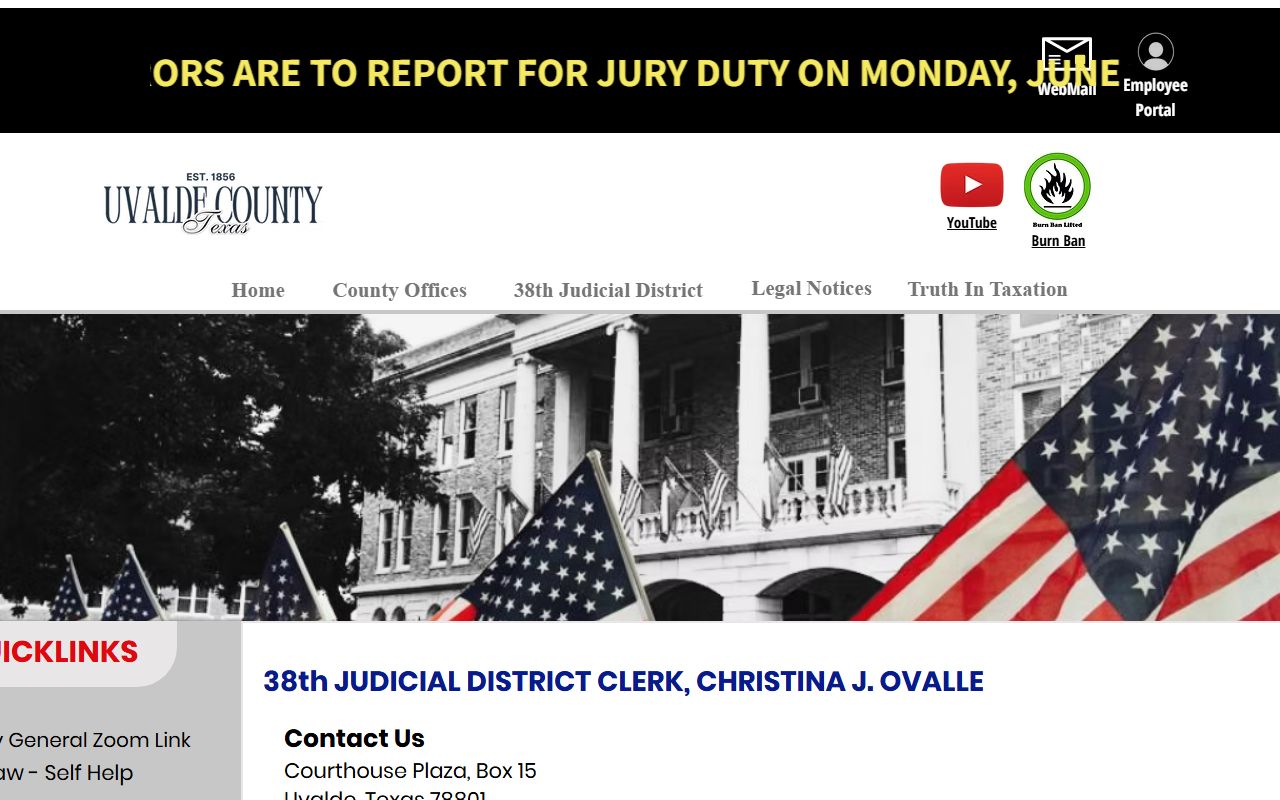
That office is central for district-level court records after a Uvalde County jail arrest, especially when the case is a felony or has moved beyond the booking stage.
Uvalde Arrest Charging Documents
Charging documents are the bridge between a Uvalde County jail arrest and the court record. A booking charge may reflect what the arresting agency believed at intake. The filed charge is the accusation placed before a court by the prosecutor or, for many felony cases, through grand-jury action. The charge name, statute, level, and case number should be checked with the clerk rather than copied from a booking note.
| Document | Who Uses It | What It Means |
|---|---|---|
| Complaint | Officer, complainant, or prosecutor path | A sworn accusation or early charging paper used in some criminal matters. |
| Information | Prosecutor | A prosecutor-filed charge used when indictment is not the charging route. |
| Indictment | Grand jury | A grand-jury charging document, commonly tied to felony prosecution. |
For adult felony arrests in Uvalde County, the 38th Judicial District Attorney contact page lists the prosecutor's office at 524 E. Nopal Street, Uvalde, TX 78801, phone 830-278-2916. The DA does not run the jail roster. Its role is deciding and prosecuting felony charges after the arrest record leaves the booking stage.
Uvalde Charge Status Records
Charge status can change more than once. A filed charge may stay pending while discovery, hearings, plea settings, or trial settings proceed. It may be amended to a different offense, reduced to a lower level, dismissed, or resolved by plea, verdict, deferred adjudication, probation, or sentence. Court records after a jail arrest should be read by date and by document type because an older booking charge can remain in one record while a newer court entry shows the case has changed.
| Status | What It Means |
|---|---|
| Pending | The charge is filed or active and no final disposition was found in the checked record. |
| Amended or reduced | The prosecutor or court record reflects a changed charge, level, or wording. |
| Dismissed | The filed charge was ended without a conviction on that count. |
| Convicted | The case ended in a guilty plea, verdict, or other conviction entry. |
| Deferred or probation | The court imposed supervision terms that must be read from the judgment or order. |
Note: A charge is an accusation; a conviction is a final court outcome after a plea, verdict, or judgment.
Bond Records After Uvalde Arrest
Bond information can appear in jail communications, magistration paperwork, and court records. Uvalde County research did not locate a local bond desk page, accepted payment list, or online bond payment system. The sourced-safe process is to confirm custody and bond status with the sheriff or jail contact under Sheriff Ruben Nolasco, then ask whether the bond is cash, surety, personal bond, or unavailable because of a hold. A detainer is a request or hold from another agency, and it can block release even when local bond appears set.
| Bond Type | How It Works | Uvalde Research Note |
|---|---|---|
| Cash bond | Money is posted directly as security for court appearance. | Local payment methods were not published in the reviewed sources. |
| Surety bond | A licensed bail bond company posts bond for a fee. | Texas permits commercial surety bail. |
| Personal or PR bond | Release is based on a promise to appear, often with conditions. | Eligibility depends on the magistrate or court. |
| No-bond hold | The person is not currently releasable by ordinary bond. | May involve serious charges, warrants, parole matters, or another agency hold. |
Uvalde Warrants and Court Records
No official Uvalde County Sheriff's active warrant search, warrant list, most-wanted page, or app-only warrant lookup was located. A warrant can still be part of court records after an arrest. Bench warrants and capiases often come from the court that handles the case, while arrest warrants may begin with law enforcement and a magistrate. For official confirmation, call the Uvalde County Sheriff's Department at (830) 278-4111 or the DA law-enforcement listing number 830-591-9000, then ask which court or agency maintains the warrant record.
Uvalde Municipal Court may be the right route for city matters. District Clerk and 38th District Court contacts are the better path for district criminal matters. Active search warrants, juvenile records, and investigative records can be restricted. A written request may help for existing non-confidential warrant records, but Texas public-information law does not force an agency to create a new answer or release records that an exception protects.
Charges, Convictions, Sealing, Expunction
Uvalde County court records after an arrest should not be read as proof of guilt. A charge means an accusation has been made or filed. A conviction means the case reached a final result through plea, verdict, or judgment. Texas also has record-clearing tools, but eligibility is case-specific. Expunction under Texas Code of Criminal Procedure Chapter 55A can remove qualifying arrest records. Nondisclosure limits some public access, but it is not the same as destroying a record.
| Comparison | First Item | Second Item |
|---|---|---|
| Charge vs. conviction | A charge is an accusation or filed count. | A conviction is a final adjudicated outcome. |
| Sealed vs. expunged | Sealed or nondisclosed records have public access limits. | Expunged records are removed or treated as qualifying law allows. |
| Booking vs. court record | Booking shows jail intake facts. | Court records show filed charges and case action. |
Important: Do not use court or jail information for credit, employment, tenant, insurance, or other FCRA-covered screening.
Restricted Uvalde Court Records
Some court and arrest records are not open in the same way as ordinary adult criminal case records. Texas Family Code Chapter 58 gives juvenile justice records separate confidentiality rules. Active investigations, sealed matters, expunction orders, privacy concerns, and court orders can also limit access. Texas Government Code Chapter 552 governs public information held by governmental bodies, while court records follow court and clerk access rules rather than the same executive-agency request path in every situation.
If a Uvalde County case cannot be found, check spelling, date of birth, arresting agency, court type, and timing. New arrests may not have a filed cause number. City cases may sit with the municipal court. Adult felonies should be routed toward the 38th Judicial District system. State prison, federal, and immigration custody records are separate from Uvalde County court records after a jail arrest.